Florence Kelley addressed her audience on behalf of children that could not represent themselves. But did she do so accurately?
She said that "several thousand little girls will be working in textile mills"; after the initial shock, the statement can make sense. The girls are working to earn money for their family and even in harsh conditions will do this. Money is a necessity and when adults alone cannot provide, children must be recruited to help. And when a family deems it necessary to send a child to work, the government has no business limiting the hours they should be allowed to work. If the little girls must adjust her work hours to nighttime in order to fit work into their school schedule, then the government should allow this to happen.
Regulating employment markets that do not need regulation will only hurt the economy, thus lowering the GDP of the nation. Children, with little time spent in school, have much to spare to work; children can naturally handle these busy schedules. Their free time is a small price to pay for the economic power of a nation.
Freedom is what this nation is founded upon. Why suddenly end this freedom when workplace rights are involved? No voters are needed to be called upon, when nothing needs to be changed.
*that was dark and awful and mean and inhumane and i do not agree with anything i just said but i wanted to argue against a point i made before
On a happy note, here is a video of Kanye singing his song "Hey Mama" with his mother. Happy Mother's Day!! Best line: Can't you see, you're like a book of poetry
Maya Angelou, Nicky Giovanni, turn one page and there's my mommy.
Sunday, May 10, 2015

Sunday, April 19, 2015
Art's art
Maus was fantastic in a brutal way; it presented the uncomfortable realities of World War II in an honest story. The contents are filled with symbolism and meaning of their own, but I would like to take a second to appreciate the underappreciated: the cover.


This art provides a look into the Nazi perspective and creates a symbol encompassing the entire book. The cover takes a point of view of a guard. Razor-wire separates the mice from the viewer, and these mice that Art develops -in this image- are not human. They all appear identical, unmarked, lacking any emotion; their uniforms are same. The rich characters and personalities that Spiegelman 136 pages to develop do not exist here.
The back also furthers the Nazi point of view. Auschwitz is depicted in a mechanical way with clear labels and an accurate map-like drawing. Instead of allowing the image of the place that killed hundreds of thousands to reflect any emotion, the picture remains stone cold.
But like the humans that lost their lives, more exists than the face value. The book may appear to reflect the Nazi ideals, but within the two covers, humanity exists. The Nazis failed to open the book and look into the lives of those they were killing; they glanced at the cover and made a choice to never open the book. The humans-- beings that loved, hated, cried, prayed, laughed, and felt every emotion as others did-- were seen as mice.
Sunday, March 29, 2015
pictures
No view can be completely unbiased. Newspapers, TV stations, books, verbal accounts, and articles are all biased. Ones views and opinions: biased. My angsty teen writing-- yup, biased.
So calling pictures biased, and taking it to the point of calling them inaccurate, might not be inaccurate after all.

An example is this picture. This is not me, nor of anyone I know (I googled tree skiing), yet I do not find any inaccuracies of it. The way the photographer took the picture made the snow look untracked, a wilderness image appear as the background, and a modern aggressive skier as the focus. This shot was set up and undoubtedly edited. If someone simply took out a point-and-shoot camera and took a picture of a skier it would not look like this; this picture is inaccurate.
But it is not. This may not be what one would see if they appeared in this situation, but this is how they would feel. An image like this evoked emotions that one in the situation of the skier would be experiencing. Photographic accuracy goes far beyond the simple contents of an image. Pictures can be an accurate representation of the human experience without being an accurate representation of the world.
Sunday, March 22, 2015
the real killers!¡!¡
Last week after track practice, I decided to go eat some much deserved Chipotle. I ordered my typical meal -- a chicken burrito with a mix of white and brown rice, pinto beans, mild salsa with a little bit of medium corn salsa, cheese, and lettuce-- but I paused for a second. We, lovers of Chipotle (1) , came and ate here often blind to the realities of what we were consuming. As we pointed our dirty, greedy fingers at whatever we desired to fill our burrito, we ignored the truth. We ignored the inhumane treatment. We turned our heads away from the human characteristics, cannibalizing our not-so-distant relatives. It reacts to differences in light; it changes its behavior when listening to music; it hangs on and fights for one thing-- life. How can we eat something so similar to us? How do we know that when our teeth rip apart its flesh it doesn't feel pain, or worse, betrayal. But still, we continue our habits, eat something that shares 50% of our own DNA.
One day, my grandchildren will ask this question: "Granddad, why did you used to eat lettuce? It had so much in common with us, like it had basic instincts that resisted death, and shared DNA, plus you made it sit in a behind a glass counter, mutilated and watch as it was slowly spread out between multiple burritos and eaten. And since we can't go into the mind of this plant, it could have been experiencing much worse. That's messed up."
And I will reply, "Child, at some point humans have to realize that some living thing has to die in order to sustain a human population of 10 billion. Creatures and plants of lower intellectual capability are a logical choice to draw this line at. Even if we didn't eat this plant, some other creature, whether it be a rabbit or a deer, would still consume it. All living things resist death-- humans, lettuce and lobsters alike-- but in order to prolong the life of one of the only guaranteed self-conscious creatures capable of a plethora of emotions, we must kill. So enjoy your lobster salad: only two small life forms died to continue yours."
(1). "lovers of Chipotle" refers to everyone, because, well, everyone loves Chipotle. And if you don't then you are wrong.

Here we witness the brutal killing of this beautfil creature.
Sunday, March 15, 2015
hours and minutes and seconds
The movie, "The Hours" posed an interesting question. Is life worth living if you live for others?
Humans are social creatures at their core; this is how we become such successful organisms. We interacted and lived alongside others. We interacted and lived for others. But not entirely. At the very core of all humans is selfishness-- we seek to help and better ourselves first and others next. "The Hours" and Mrs. Dalloway present characters who have lost their own motive to live. Septimus, Richard, Virgina, and Laura have lost their connection to humanity; they lost the instincts that make them human; they lost a reason to live-- besides to exist for the sake of others. Richard realizes this when he says "I think I'm staying alive just to satisfy you". If he loses his basic instinct, nothing keeps him ending his life. And he does.
 Although the idea of living a life for others seems awful, the opposite seems just as bad. Living a life entirely out of selfishness. Humans cannot survive living in either of these extremes; we must find a life that includes the desires of others, as well as personal needs. If only Richard had. I wouldn't have been so sad watching that movie.
Humans are social creatures at their core; this is how we become such successful organisms. We interacted and lived alongside others. We interacted and lived for others. But not entirely. At the very core of all humans is selfishness-- we seek to help and better ourselves first and others next. "The Hours" and Mrs. Dalloway present characters who have lost their own motive to live. Septimus, Richard, Virgina, and Laura have lost their connection to humanity; they lost the instincts that make them human; they lost a reason to live-- besides to exist for the sake of others. Richard realizes this when he says "I think I'm staying alive just to satisfy you". If he loses his basic instinct, nothing keeps him ending his life. And he does.
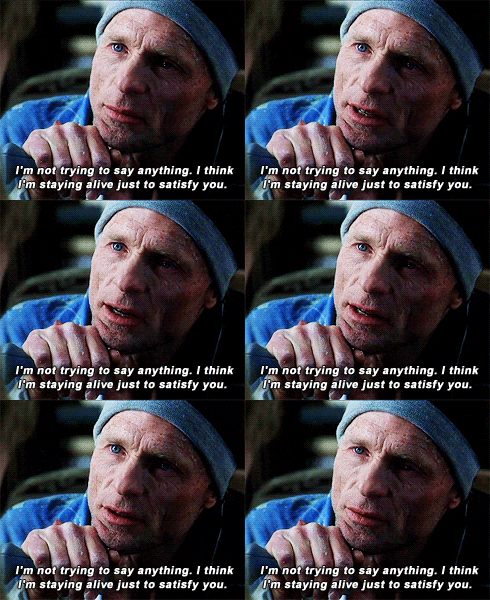 Although the idea of living a life for others seems awful, the opposite seems just as bad. Living a life entirely out of selfishness. Humans cannot survive living in either of these extremes; we must find a life that includes the desires of others, as well as personal needs. If only Richard had. I wouldn't have been so sad watching that movie.
Sunday, March 8, 2015
pink floyd and virginia woolf
I was listening to Dark Side of the Moon, a Pink Floyd album, while trying to figure out what to write about. Then the song "The Great Gig In The Sky" came on.
In Mrs. Dalloway, by Virginia Woolf, as Peter Walch ponders life, a voice "interrupted him" (80). This voice "bubble[s]" up through the earth, spewing a message that is not human-- the sounds "ee um fah um so foo swee too eem oo" have no meaning. But they have all the meaning.
In "The Great Gig In The Sky", the beginning of the song features a quiet voice. Random words and thoughts can be heard over the piano intro. Then the song really begins. A voice soars over the man talking and begins a melody-- but with no words. Only moans and cries can be heard over the piano, drums, guitar, and bass. The sounds have no English meaning. But they have all the meaning.
The words of both examples mean something greater than language can give to them: they speak of a universal truth. Woolf's voice "stood singing of love-- love which lasted millions of years,"; this "ancient sound" exists because the universal meaning of love is not affected by time (81). Similar to Pink Floyd's rendition, no real words are needed. The emotions and meanings can be taken from the wailing sounds. Even the title of the song, with the inclusion of the words "in the sky" can help to determine the message. Something omnipresent, and greater-than-human is suggested.
But most of all, the sounds of the woman singing seem exactly how Virgina Woolf would have intended the voice in Mrs. Dalloway to be heard.
Sunday, March 1, 2015
the awful, awful! septimus
"But he himself remained high on his rock, like a drowned sailor on a rock. I leant over the edge of the boat and fell down, he thought. I went under the sea. I have been dead, and yet am now alive, but let me rest still; he begged (he was talking to himself again — it was awful, awful!); and as, before waking, the voices of birds and the sound of wheels chime and chatter in a queer harmony, grow louder and louder and the sleeper feels himself drawing to the shores of life, so he felt himself drawing towards life, the sun growing hotter, cries sounding louder, something tremendous about to happen."
Septimus is alone-- truly alone. His PTSD has isolated him to the point where he sits in Regent Park, but still feels stranded from society. Even doctors, supposedly experts of health, can provide little help his situation. The events of World War I have left him "dead". Septimus sits in the park and reveals the paradox that rules his life: he has "been dead, and yet [is] now alive". But he knows he has only momentarily escaped his fate. Like a sailor that has survived the initial crash of a ship into a rock, he sits isolated, waiting either for the seas to rip him back into the black water, or to die a lonesome death perched on the rock. His own isolation is represented in Woolf's use of syntax. By adding parenthesis of his own response, a conversation occurs; except this is dialogue is with himself. As this except continues, hope shines through. He hears "the voices of birds and the sound of wheels" as he sits on his rock. This is not in real. No birds would be flying in the middle of the ocean during a storm, no wheels would be anywhere near him; this is death-- beautiful and comforting-- welcoming-- like the Sirens luring sailors to drown themselves-- Septimus to it. Like the Sirens luring sailors to drown themselves.

Subscribe to:
Posts (Atom)